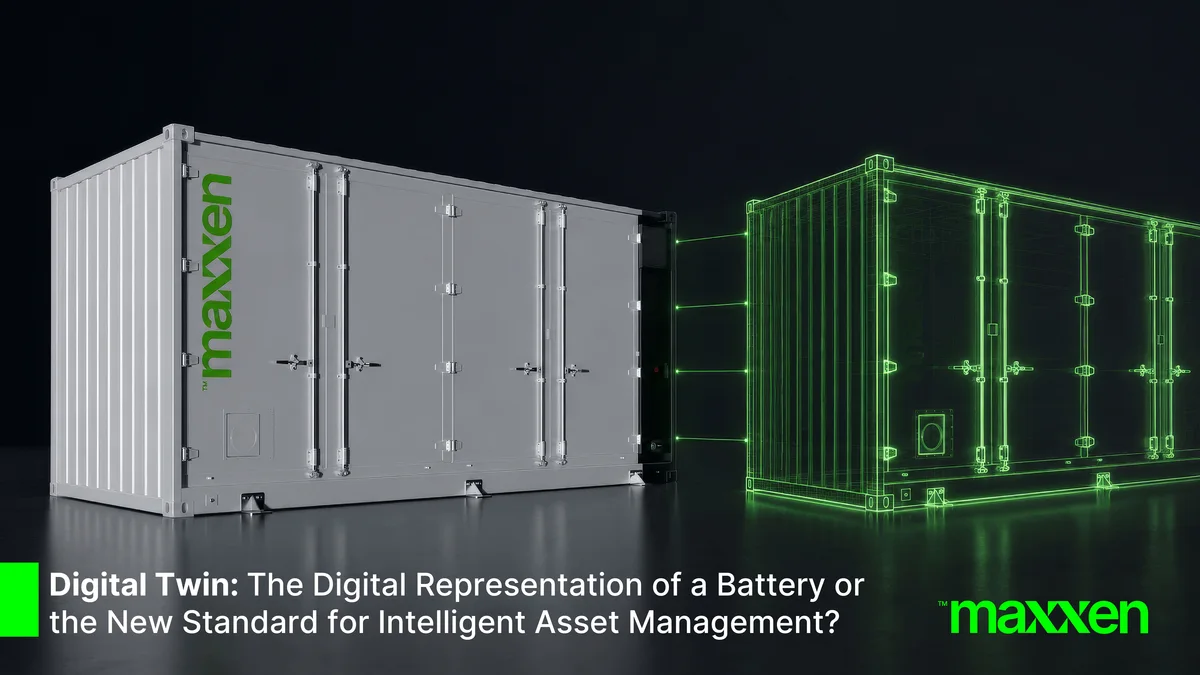
In energy storage systems, real value comes not only from monitoring today's performance, but also from reliably anticipating what lies ahead. In this newsletter by Maxxen Product & Technology Director Uğur Can Orhan, we explore how Digital Twin technology is transforming technical performance, investment decisions, and lifecycle asset management in BESS projects. Read the full newsletter to discover the value of Digital Twin beyond conventional monitoring. #MaxxenEnergy
As manufacturing continues to evolve through lean principles, Kaizen, Agile methodologies, sustainability initiatives, and artificial intelligence, another concept has rapidly emerged as a defining technology across the engineering landscape: the Digital Twin.
Like many technological terms, "Digital Twin" has become increasingly widespread. Today, numerous solutions supported by sensor networks, advanced monitoring systems, and data acquisition platforms are described as digital twins.
In Battery Energy Storage Systems (BESS), however, the distinction is far more than a matter of terminology. A properly implemented Digital Twin represents a strategic capability that influences asset performance and warranty management for manufacturers, financial forecasting for investors, and long-term operational efficiency and asset lifetime for system operators.
A true Digital Twin extends well beyond real-time monitoring. It should be capable of predicting future system behaviour, evaluating potential performance degradation, and providing reliable insights that support engineering and operational decision-making.Advanced monitoring systems are, without question, an essential component of modern energy infrastructure. Nevertheless, there remains a significant technical distinction between comprehensive data visualization and a genuine Digital Twin architecture.
Rather than approaching the subject from a purely academic perspective, this article examines how Digital Twin technology creates measurable value in Battery Energy Storage Systems from the viewpoints of manufacturers, investors, and asset operators.
Simulation Is Not New—Its Application to Battery Systems Is
Engineering disciplines have relied on simulation technologies for decades.
Computer-Aided Engineering (CAE) enables engineers to predict structural deformation under mechanical loads, evaluate thermal behaviour, and analyse fluid dynamics long before a physical product is manufactured. Virtual validation has become an integral part of modern engineering practice.
Battery systems, however, introduce a significantly higher level of complexity.
Electrical behaviour, thermal dynamics, electrochemical reactions, operating conditions, and ageing mechanisms must all be considered simultaneously. As modelling progresses from the cell level to modules, packs, containers, and ultimately utility-scale systems, additional variables—including interconnections, auxiliary systems, thermal management, and cell-to-cell variability—must also be incorporated.
Although increasing model complexity may theoretically improve the representation of the physical system, greater complexity does not necessarily translate into higher accuracy. If critical variables cannot be measured or experimentally validated, increasingly sophisticated models may still produce unreliable results.
Consequently, the value of battery modelling is determined not by model complexity itself, but by the extent to which the model is validated through laboratory characterisation and real-world operational data.
While mechanical and thermal simulations benefit from decades of established validation methodologies, electrochemical modelling remains a rapidly evolving discipline. Moreover, predicting battery behaviour over several hours is fundamentally different from forecasting degradation mechanisms over an eight- or ten-year operational lifetime.
What Questions Should a Digital Twin Answer?
Battery Management Systems (BMS) already monitor parameters such as State of Charge (SoC), voltage, temperature, and system alarms.
A Digital Twin is expected to provide a significantly higher level of operational and strategic intelligence by answering questions such as:
Is the battery degrading faster than expected?
If the current operating strategy continues, what usable capacity will remain after several years?
Why are certain racks ageing differently from others?
How will today's revenue optimisation strategy influence long-term battery degradation?
Is the thermal management system maintaining protection while operating at optimal energy efficiency?
When is the most appropriate time for maintenance or capacity augmentation?
How would an alternative operating strategy affect both project revenue and battery ageing?
When a Digital Twin can reliably answer these questions, it evolves beyond a monitoring platform into an engineering decision-support system and a comprehensive asset management solution.
The defining characteristic is confidence.
No model can predict every outcome with absolute certainty. However, a robust Digital Twin architecture should transparently communicate both the confidence level of its predictions and the associated uncertainty.
In engineering, a reliable prediction with clearly defined confidence limits is considerably more valuable than an unverified result presented with unwarranted certainty.
The True Value of an Investment Is Measured Over Time
The initial power and energy ratings of a BESS project are well defined during the design phase and subsequently verified through factory and site acceptance testing.
The more important question is how effectively the system will sustain that performance throughout its operational lifetime.
Key questions include:
Will actual field performance follow the assumptions used in the financial model?
Can projected revenues be maintained while remaining within warranty conditions?
Will auxiliary power consumption remain within expected limits?
When will capacity augmentation become necessary?
How will unplanned outages affect the project's lifetime return on investment?
Will the usable energy available in Year 10 align with the assumptions used during the investment decision?
The Total Cost of Ownership (TCO) of a Battery Energy Storage System extends far beyond its initial capital investment. Capacity degradation, maintenance activities, auxiliary energy consumption, component replacement, capacity expansion, and unplanned downtime collectively determine the long-term economic performance of the asset.
Similarly, warranties alone do not guarantee system performance. Warranty compliance depends on multiple operational parameters, including temperature, operating window, energy throughput, maintenance practices, and dispatch strategy. Continuous monitoring of these conditions is therefore essential not only for warranty compliance but also for sustaining long-term asset performance.
This is where an advanced Battery Intelligence framework delivers measurable value. Continuously comparing real-world operating data against warranty performance curves enables early detection of unexpected degradation, improves maintenance and augmentation planning, and supports engineering decisions with validated operational data.
Ultimately, the greatest value of a Digital Twin for investors is not the generation of additional operational data. Its real contribution lies in improving performance predictability, reducing operational uncertainty, and enabling more informed investment decisions through data-driven engineering insights.
Delivering Measurable Value: The Impact of Digital Twins on BESS Projects
The tangible value created by Digital Twin technology in Battery Energy Storage Systems (BESS) has been extensively investigated through both academic research and real-world deployments over the past several years.
Given the diversity of system architectures, operating strategies, market conditions, and modelling methodologies adopted across these studies, their findings should not be interpreted as universally applicable to every BESS project. Nevertheless, the growing body of research provides valuable evidence of the potential benefits that Digital Twin technologies can deliver throughout the asset lifecycle.
In one study involving a utility-scale battery system comprising approximately 19,000 battery cells, the battery system, power electronics, thermal management system, and degradation mechanisms were modelled as an integrated digital representation. By implementing advanced thermal control strategies, researchers reported approximately 5% improvement in overall system efficiency and a further 5% increase in available energy after ten years of operation.
These improvements extend beyond enhanced cooling performance alone. They indicate broader operational benefits, including reduced auxiliary energy consumption, increased usable capacity, and the postponement of capacity augmentation—each contributing directly to long-term asset value.
Another study demonstrated that integrating battery degradation models into dispatch and operating strategies increased lifetime project profitability by between 24.9% and 29.3% compared with conventional ageing models.
Importantly, this additional value was not created by the Digital Twin software itself. Rather, it resulted from incorporating a more accurate representation of battery ageing into operational decision-making.
Similarly, a year-long experimental study reported that an operating strategy based on advanced degradation models achieved approximately 20% higher project revenue while reducing battery degradation by nearly 30% compared with a conventional reference strategy.
These findings should not be interpreted as guaranteed performance improvements or universally achievable investment returns. They do, however, consistently demonstrate one fundamental principle:
More accurate representation of battery behaviour—and the integration of this knowledge into operational decision-making—can improve not only technical performance but also the long-term economic performance of battery assets.
Can Digital Twins Reduce CAPEX?
There is currently no universally accepted evidence demonstrating that Digital Twin technology consistently reduces either Capital Expenditure (CAPEX) or Operating Expenditure (OPEX) by a predefined percentage across Battery Energy Storage projects.
In fact, implementing a Digital Twin may initially increase project costs due to investments in additional sensing infrastructure, data acquisition systems, laboratory characterisation, model development, software integration, data management, and cybersecurity.
The economic value of a Digital Twin is therefore realised primarily throughout the operational life of the asset rather than during project construction.
Potential lifecycle benefits include:
Optimising engineering safety margins during system design
More accurate sizing of thermal management systems
Virtual validation of control strategies before deployment
Deferring capacity augmentation
Reducing unplanned equipment replacement
It is important to distinguish between technical improvements and their associated financial outcomes.
For example, a 5% increase in available energy after long-term operation may represent substantial economic value for a utility-scale project. However, the financial impact depends entirely on project-specific variables such as revenue mechanisms, investment costs, market participation, and augmentation strategies.
For this reason, it is more appropriate to conclude that:
A Digital Twin may not necessarily reduce initial capital expenditure; however, it can significantly reduce long-term investment risks by mitigating design errors, delaying capacity augmentation, and minimising unplanned equipment replacement throughout the asset lifecycle.
Long-Term Value Is Driven by OPEX Optimisation and Intelligent Asset Management
For most BESS applications, the economic value of a Digital Twin becomes most evident through reduced operating costs and enhanced lifecycle asset performance.
Its contribution extends well beyond maintenance optimisation.
A Digital Twin supports intelligent asset management by enabling:
Reduced auxiliary power consumption
Early detection of performance deviations
Condition-based maintenance planning
Continuous warranty compliance monitoring
Joint optimisation of market revenues and battery degradation
From an investment perspective, the overall value created by a Digital Twin is determined by balancing additional revenue, preserved usable capacity, deferred augmentation, avoided unplanned outages, lower maintenance costs, and reduced auxiliary consumption against the cost of implementation, integration, and operation.
Ultimately, the success of a Digital Twin should not be measured solely by the sophistication of its dashboards or visualisation capabilities. Its true value lies in its ability to generate measurable economic benefits throughout the entire lifecycle of the asset.
The Foundation of Reliable Predictions: Battery Cell Modelling
The reliability of any BESS Digital Twin begins with an accurate representation of battery cell behaviour.
A model that cannot accurately reproduce fundamental parameters such as voltage, temperature, available capacity, and internal resistance may process large amounts of data without necessarily producing more reliable engineering decisions.
Today, battery cell models generally fall into three principal categories.
Equivalent Circuit Models
Equivalent Circuit Models (ECMs) represent battery electrical behaviour using simplified electrical components.
Their computational efficiency makes them well suited for real-time applications such as voltage prediction, state estimation, and battery management.
However, model accuracy typically requires recalibration as temperature, operating conditions, and battery ageing evolve over time.
Consequently, while ECMs provide significant advantages for real-time operation, they remain limited in their ability to describe the underlying physical mechanisms responsible for battery degradation.
Physics-Based Models
Physics-based models aim to reproduce the electrochemical processes occurring within battery cells at a much higher level of physical fidelity.
Such models enable more accurate analysis of variables that cannot be directly measured, including internal temperature distributions, electrode behaviour, and electrochemical safety limits.
Their implementation, however, requires extensive experimental characterisation, significantly more model parameters, and substantially greater computational resources. Since much of the required information is not available in standard manufacturer datasheets, laboratory testing and experimental validation become essential.
Accordingly, the predictive capability of physics-based models depends not only on their governing equations but equally on the quality, completeness, and accuracy of the laboratory data used for model parameterisation.
Data-Driven Models
Data-driven models leverage Artificial Intelligence and Machine Learning algorithms to identify patterns within historical operational data.
When trained using sufficiently large, representative, and high-quality datasets, these models can achieve excellent performance in applications including anomaly detection, temperature prediction, capacity fade analysis, and Remaining Useful Life (RUL) estimation.
However, prediction accuracy may deteriorate when operating conditions differ significantly from the data used during training—for example under unfamiliar climate conditions, new operating strategies, or previously unseen degradation mechanisms.
For this reason, purely data-driven approaches are generally most effective when combined with physics-based modelling rather than replacing it.
Hybrid Modelling: The Industry Standard
The most advanced Digital Twin platforms increasingly rely on hybrid modelling, combining multiple modelling methodologies to exploit the strengths of each approach.
Running highly detailed electrochemical models for every battery cell in real time remains computationally prohibitive for commercial utility-scale BESS applications.
Conversely, relying solely on simplified electrical models may be insufficient to accurately capture degradation mechanisms and operational safety limits. Likewise, purely AI-driven models may struggle to maintain prediction accuracy outside the range of their training data.
Hybrid modelling provides the optimal balance between computational efficiency and predictive accuracy.
Physics-based models define the underlying physical constraints governing battery behaviour, equivalent circuit models enable real-time simulation, while Artificial Intelligence enhances computational efficiency, detects deviations in operational data, and continuously refines model performance using field observations.
Advances in computing power have also enabled many simulation techniques that were previously limited to offline analysis to operate increasingly close to real time through surrogate models and AI-assisted computation. This allows detailed electrochemical knowledge to be integrated more effectively into operational decision-making.
Nevertheless, computational speed should never be confused with engineering accuracy.
A faster model creates value only when it is built upon experimentally validated engineering principles.
Artificial Intelligence should therefore be viewed not as a replacement for physics-based modelling, but as a complementary technology that enhances its accuracy, scalability, and practical deployment.
The Importance of Laboratory Characterisation
A reliable Digital Twin architecture is fundamentally built upon comprehensive laboratory characterisation.
Standard technical documentation defines the basic operating limits of a battery cell. However, developing a trustworthy Digital Twin requires experimentally characterising cell behaviour across a wide range of temperatures, power levels, operating windows, and duty cycles.
Furthermore, battery degradation cannot be explained solely by cycle count. Temperature, calendar ageing, operating window, energy throughput, dwell time, and dispatch profile collectively influence long-term degradation behaviour.
For this reason, a reliable Digital Twin depends on two complementary sources of information.
Laboratory data establishes the model's initial physical accuracy, while operational field data enables continuous calibration, adaptation to real-world operating conditions, and validation throughout the asset's lifecycle.
Models developed exclusively from laboratory characterisation may fail to capture the variability encountered in real operating environments. Conversely, models trained solely on field data often lack the physical understanding required to explain the underlying degradation mechanisms.
A robust Digital Twin therefore combines experimentally validated laboratory models with continuously acquired operational data to achieve both physical fidelity and long-term predictive reliability.
From Cell Models to System-Level Intelligence
Accurate modelling of an individual battery cell is an essential foundation for any Digital Twin. However, it is not sufficient to represent the behaviour of an entire Battery Energy Storage System.
In real-world BESS applications, battery cells do not age uniformly. Rack configuration, electrical interconnections, temperature gradients, sensor placement, thermal management performance, and operational strategies all influence system behaviour.
Moreover, a utility-scale battery plant comprises far more than battery cells alone.
The Battery Management System (BMS), Power Conversion System (PCS), Energy Management System (EMS), thermal management system, fire protection, transformers, and auxiliary systems collectively determine overall plant performance.
Individual subsystems may influence total system performance independently. For example, the battery may retain its expected capacity while an inefficient cooling system increases auxiliary power consumption. Similarly, PCS conversion losses may reduce round-trip efficiency despite healthy battery performance. Different racks may exhibit different degradation characteristics, or an operating strategy designed to maximise short-term revenue may accelerate long-term capacity fade.
The principal advantage of a system-level Digital Twin is its ability to evaluate these complex interactions within a unified analytical framework.
While cell-level modelling quantifies electrochemical performance, system-level Digital Twins connect technical performance directly with operational and financial outcomes.
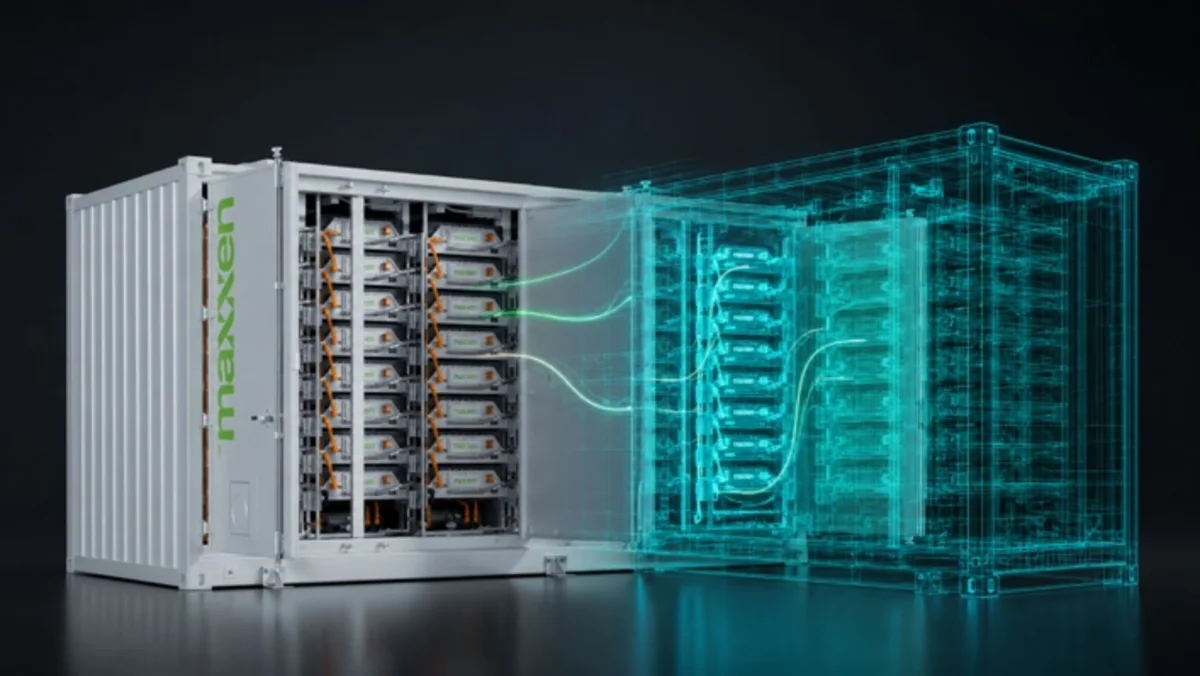
Digital Twins at the Power Plant Level
At the power plant level, a Digital Twin integrates the battery model with every major subsystem across the facility.
BMS, PCS, EMS, SCADA, thermal management, transformers, site conditions, grid interfaces, and electricity market signals become part of a single, interconnected decision-support environment.
The objective extends far beyond equipment monitoring. It is to optimise both the technical and economic performance of the entire energy storage asset.
Alternative operating strategies can be validated virtually before implementation. Changes to control software can be evaluated without affecting the physical installation. Likewise, the impact of thermal management strategies on auxiliary energy consumption, battery lifetime, and system efficiency can be assessed before deployment.
Maintenance scheduling can also be optimised by simultaneously considering technical condition, operational requirements, and economic performance.
Typical applications of power plant-level Digital Twins include:
Real-time operational monitoring
Scenario simulation
Remaining Useful Life (RUL) prediction
Predictive maintenance optimisation
Operator decision support
The economic benefits of this approach have already been demonstrated across multiple energy sectors beyond battery storage.
A 2026 study involving a 660 MW thermal power plant reported annual operating cost savings of approximately USD 13 million, together with a reduction of approximately 28,000 tonnes of CO₂ emissions, achieved through a data-driven Digital Twin implementation.
These findings should not be directly extrapolated to Battery Energy Storage Systems. Nevertheless, they clearly demonstrate that relatively small improvements achieved through system-level optimisation can generate substantial economic value over an asset's operational lifetime.
For BESS applications, similar value may be realised through:
Reduced auxiliary energy consumption
Higher preserved usable capacity
Optimised degradation management
Increased market revenues
Reduced unplanned downtime
How Should Model Accuracy Be Evaluated?
Model accuracy cannot be expressed by a single performance metric.
Its effectiveness depends on multiple factors, including battery chemistry, operating temperature, dispatch profile, degradation state, and the range of conditions under which the model has been validated.
Today, highly accurate predictions can be achieved for short-term variables such as voltage and temperature. Long-term degradation forecasting and Remaining Useful Life estimation, however, remain among the most challenging problems in battery engineering.
A model that accurately represents current operating conditions should not automatically be assumed capable of predicting long-term capacity evolution with the same level of confidence.
Accordingly, investors and asset owners should evaluate more than headline accuracy figures.
Key questions include:
Under which operating conditions was the model validated?
How frequently is the model compared against operational field data?
Is the model recalibrated following software updates or system modifications?
Are prediction uncertainties explicitly quantified and reported?
Under which operating conditions does model accuracy begin to deteriorate?
A reliable Digital Twin is therefore not a static engineering model developed once during system commissioning. It is a continuously validated and continuously evolving digital representation that adapts throughout the entire lifecycle of the asset.
Practical Implementation Challenges
One of the primary requirements for a successful Digital Twin implementation is a high-quality data infrastructure.
Sensor accuracy, timestamp synchronisation, and consistency across multiple data sources directly influence model reliability.
System integration represents another major engineering challenge.
Integrating data from the BMS, PCS, EMS, and auxiliary systems into a unified data architecture often requires project-specific engineering and system integration efforts.
Differences in data structures, sampling frequencies, communication protocols, and alarm logic can significantly increase implementation complexity.
Even the most sophisticated Digital Twin model may fail to deliver its expected performance if the underlying data infrastructure is inadequate.
Lifecycle model governance is equally important.
Software updates, hardware modifications, and changes in operating strategy all require continuous model validation and recalibration to maintain predictive accuracy.
It is also important to recognise that the most sophisticated Digital Twin architecture is not necessarily the most economically appropriate solution for every project.
In some applications, advanced monitoring, alarm management, and performance analytics may provide sufficient value. Larger and more complex utility-scale assets, however, can justify the investment required for comprehensive Digital Twin architectures.
The engineering objective should therefore not be to develop the most technically complex Digital Twin possible, but rather to implement the solution that delivers the greatest value for the project's scale, operational risk profile, and commercial objectives.
At Maxxen, our research and development activities span the full Digital Twin technology stack—from battery cell characterisation and Battery Intelligence platforms to lifetime prediction models and utility-scale Digital Twin architectures.
Our objective extends beyond developing high-performance battery systems. We aim to deliver intelligent digital solutions that enable predictive, data-driven, and sustainable asset management throughout the entire lifecycle of energy storage systems.
As the energy storage industry continues to mature, competitive advantage will increasingly be determined not only by hardware performance, but by the ability to understand system behaviour, transform operational data into engineering intelligence, and convert that intelligence into measurable business value.
Uğur Can Orhan
Maxxen
Product & Technology Director
NIST – Digital Twins: Essential Elements https://www.nist.gov/digital-twins/essential-elements
U.S. Department of Energy – Rapid Operational Validation Initiative https://www.energy.gov/oe/rapid-operational-validation-initiative-rovi
OSTI / NREL – Digital Twin + AI: Control Room of the Future https://www.osti.gov/biblio/2477382
World Bank – Economic Analysis of Battery Energy Storage Systems https://openknowledge.worldbank.org/entities/publication/9bd48668-674b-5059-b496-022e5a27d232
World Bank / ESMAP – Warranties for Battery Energy Storage Systems in Developing Countries https://www.esmap.org/report-warranties-for-battery-energy-storage-systems-in-dev
Applied Energy – Digital Twin of a MWh-Scale Grid Battery System for Efficiency and Degradation Analysis https://www.sciencedirect.com/science/article/pii/S0306261923001381
Applied Energy – Increasing the Lifetime Profitability of Battery Energy Storage Systems Through Aging-Aware Operation https://www.sciencedirect.com/science/article/pii/S0306261923008954
University of Oxford – Unlocking Extra Value from Grid Batteries Using Advanced Models https://ora.ox.ac.uk/objects/uuid%3Af2512ae9-1b01-464c-9bc1-ee2ceda6341a/files/s3197xn011
Energy – Data-Efficient Digital Twin for Turbine Heat Rate of an Industrial Thermal Power Plant https://ideas.repec.org/a/eee/energy/v345y2026ics0360544226003403.html